Showing posts with label Hard Sparks. Show all posts

Tuesday, September 19, 2017

The Cabaret At The End Of The World

Written by Melody Bates
Directed by Joan Jubett
Produced by Hard Sparks in association with IRT Theater

Nominations: Outstanding Choreography: Hettie Barnhill; Outstanding Sound Design: John Salutz; Outstanding Original Full Length Script: Melody Bates; Outstanding Original Music: Melody Bates; Outstanding Original Music: Rebecca Hart


About the Production

The Cabaret At The End Of The World leads audiences through Julius Caesar with the vibrant Flora and Fawna as guides, inviting you to the “hottest club in Ancient Rome” for an adaptation full of burlesque numbers, clever satire and themes of modern society. 

In this exclusive interview, 2017 NYIT nominees Hettie Barnhill, Melody Bates and Rebecca Hart share their process creating new and innovative theatre with a reference point we know so well.


l to r: Melody Bates, Samantha Bilinkas. Photo by Jody Christopherson.
_______________________________________________________________________________

What attracted you to this production?
Hettie
: The writer Melody Bates and I met while performing at the Metropolitan Opera, I knew of her previous work and loved it. So when she asked me come on board it was a Yes!

Melody: Meg Taintor, Artistic Director of Opera House Arts at the Stonington Opera House, and I started talking about creating a new work that takes off from Julius Caesar. Ideally it would be something musical, something comedic, and something that illuminated Shakespeare’s play in a new way. Meg was into it, and I asked Rebecca Hart to help me write it. When she said yes I thought, “okay, we’re doing a two-woman cabaret based on Julius Caesar” …which turned out to be way more subversive than I expected, as I’ll get into below. So we’re sisters, Flora and Fawna, and we run the hottest underground club in ancient Rome. It’s the kind of place where everyone is welcome and people from all parts of society can mix and mingle with an expectation of peace. We’re just there to do our big Ides of March show, but the events of Shakespeare's play start happening outside and we have to deal with them. It’s a classic clown set-up: we have a thing we’re trying to do, and other things keep getting in our way. Shakespeare’s play becomes the obstacle to ours, and hilarity and illumination ensue.

Rebecca: I love adaptation; I love telling a well-known story from a fresh angle and I loved the sound of "two women do Julius Caesar". I liked the irreverence and the humor of it. I liked writing songs for Portia and Calpurnia. Also, Melody asked me to work on it.


What was your favorite part of working on this production?
Hettie: Bringing the humor into the movement and working with the team, it was very organic, which made it the entire experience a delight!

Melody: There is a thing that happens in rehearsal when I have written funny scenes, and I am playing one of the characters in the funny scenes, especially when my acting partners are very good. I turn into a giggle monster. It’s ridiculous. But it has the one redeeming factor that it’s also a sign that we’re getting the scene right. So there’s this scene in Cabaret at the End of the World where my sister Fawna is trying to tell a knock-knock joke, and my character Flora doesn’t know how a knock-knock joke works. It’s one of my favorite funny things I’ve ever written. And Sam Bilinkas, who played Fawna, kept making me crack in rehearsal. I just love making people laugh so much! And when I can feel us getting there, I might as well be a three-year-old seeing a pie-in-the-face gag for the first time. It’s sheer delight. I get it together eventually. At least by the time the audience arrives. But the part of the process where the other actors are making the writer in me laugh like a little kid—I’m grateful for their tolerance, and it sure is a good time.

Rebecca: Being a composer/songwriter on a show is a fairly new role for me, and I loved going to see the play and hearing the songs in performance.


l to r: Melody Bates, Samantha Bilinkas. Photo by Jody Christopherson.


What was the most challenging part of working on this production?

 
Hettie: Balancing the thin line between "slap-stick" and "silliness". Also making sure that the two main stars were able to confidently deliver their lines while performing my movement.

Melody: In the summer of 2016, not long after the first version of this play was commissioned, J.Stephen Brantley suggested producing it in New York. We were both excited about the prospect. I knew I’d want to do some rewrites, and I knew there was time to do so before the scheduled run in March 2017.

Then the election happened.

After the body-blow of that November day, it took me some time to find my words. The first thing I knew for sure was that the satire in this play about two women dealing with the Roman patriarchy was probably going to take a turn for the darker.

Which it did. And it made the play better. Balancing the bleak reality of inequality with an inextinguishable hope for something better—exercising our ability to find humor in dark times and letting that give us strength to keep going: that feels completely of the moment right now. Negotiating that balance led to discoveries like the standout anthem “Resist,” which was the final song that Rebecca wrote for the show. Satire and ridicule, and the supernova power of art to speak truth to power are essential tools in dark times. So the biggest challenge turned out to be overcoming post-election despair and rage and finding that balance. Even to the point of allowing for hope. Stubborn, stupid, relentless, gossamer hope, knocking from the inside of Pandora’s box to be set free. I feel almost embarrassed to feel the possibility of hope, because what we’re facing is so terrible. But still: get up. Keep going. Resist. Or as a fortune from a fortune cookie that I keep on my dresser says: “Keep charging the enemy as long as there is life.” 

Rebecca: Writing chord charts.


What was your favorite part about working with this group of artists?
Hettie: The shenanigans! No... really the diverseness in talent.

Melody: Hard Sparks is an incredible company. The visionary and brilliant J.Stephen Brantley is a mentor, an inspiration, a gorgeous writer, one of my favorite acting partners, a kick-ass producer, and one of the best human beings I know. Along with Robert Lohman, he runs an independent theatre company that lives up to its mission of championing daring productions of adventurous new plays. They take on the impossible, the improbable, the wild, the jump-off-a-cliff-and-see-if-we-fly stuff. Which is probably why I love them—I’m into that, too. And the company who coalesced around The Cabaret at the End of the World was wonderful. Actors Samantha Bilinkas, Connor Bond, Rachel Murdy (in addition to J.Stephen and myself), our intern Guillermo Sanchez-Vela, our stage manager Darielle Shandler, music director Peter Szep, fight choreographer Dan Renkin, costume designer Liz Kurtzman, our generous and gifted director Joan Jubett, everyone on our production team. And of course the great Rebecca Hart, whom I have known since we spent a magical summer together playing Titania and Hermia in Maine, who is a joy to collaborate with and a musical genius.

Rebecca: How game everyone is to be both totally ridiculous and totally sincere in the same show. Also how much they obviously enjoyed singing the tunes.


l to r: Rachel Mundy, Melody Bates, Samantha Bilinkas, Connor Bond. Photo by Jody Christopherson.


What did you learn from working on this production?
Hettie: My love for classic texts. 

Melody: The overall ratio of male roles to female roles in classical theatre is 7 to 3. In Julius Caesar, it’s 49 to 2. 

I mean, holy sh*t.

I knew it was bad, but I didn’t realize it was that bad until I sat down with the dramatis personae and counted. On top of that, most of the characters in the play are aristocrats. So it turns out that just telling the story of this story from the perspective of two non-aristocratic women is a revolutionary act. 

The surprises continued thanks to Rachel Murdy’s offer to help with the show, in whatever capacity. I know what’s good for me so I decided to write a role for her. “What if I’m sort of an Anfisa character, like an old discarded servant?” she suggested. I told her I couldn’t be less interested in writing an old discarded woman character. "But," I said, "…what if you’re a goddess in disguise?” Thus was born Feronia, the Sabine goddess “who came with the building,” whose arrival also led to a major discovery about the Sabines and the founding myth of Rome.

Rome was founded through a massive, Boko Haram-style kidnapping and rape. 

I’d certainly seen depictions of the Rape of the Sabine Women in art history. But no one ever taught it to me for what it was: the pre-meditated abduction and rape of hundreds of women, because the Roman generals had established a city of all men, and decided to kidnap and enslave women so they could create future generations of Romans. This is the great Rome, the seat of democracy. Founded on kidnapping and rape. I knew history had a man-washing problem, but researching and developing the play brought it home in a whole new way.

Playwrights make choices about whose stories matter. Our historical accounts, including our literature and art, suffer from man-washing. Check out Livy’s insane account of the rape of the Sabine women if you have any doubts. We’re living in a moment when many male lawmakers seem to have no theory of mind when it comes to women—they fail to empathize with a woman’s experience unless they can imagine it through another man's mind. Hence the “I have a mother/ sister/ wife/ daughter, therefore I don’t want bad things to happen to other men’s mothers/ sisters etc.” nonsense. It’s infuriating. So these discoveries gave us the opportunity to tangle with Roman history in a new way, to give voice to the half of society that has largely been ignored. The Cabaret at the End of the World is subversive because it makes you laugh and takes you on a ride and shows you a good time—and underneath it is a steely demand that you join us in fighting for equality, for love, for a better world.


You can follow Hard Spark’s here:
Twitter: @HardSparks
Instagram: @hardsparks


Wednesday, August 23, 2017

The Jamb

Written by J.Stephen Brantley
Directed by David Drake
Produced by Hard Sparks in association with Horse Trade Theatre Group


Nominations: Outstanding Director: David Drake; Outstanding Actor in a Lead Role: Nico Grelli


Nic Grelli (left), J.Stephen Brantley (right). Photo by Hunter Canning.
 

About the Company
HARD SPARKS champions daring performances of adventurous new plays. Since 2011, the company has worked with fifty-one actors, nine playwrights, six directors, and eighteen designers on eleven productions in thirteen venues. Hard Sparks has been nominated for eleven New York Innovative Theatre Awards including Outstanding Premiere Production for EIGHTYTHREE DOWN, Outstanding Short Script for CHICKEN-FRIED CICCONE, and Outstanding Revival for R & J & Z. In trying times, Hard Sparks tells tales of transformation and redemption, mining our darkness for light.

About the Production
Set in 2008, gay punks Tuffer and Roderick are turning forty. Both can’t face it, leaving them to cope in different ways. Tuffer continues on his journey of smoking, snorting, and screwing Manhattan men while Roderick goes completely straight edge. When Roderick comes to his wits end in dealing with Tuffer's shenanigans, Tuffer agrees to get sober at Roderick's folk-singing mothers house. Both hit bottom on the high desert, on the edge, in the jamb.

David Drake and Nico Grelli talk about their experiences working on this project.


________________________________________________________________________________

What attracted you to this project?
J. Stephen: THE JAMB was a long time coming. As both playwright and producer, I'd seen this play through seven years of readings, workshops, and near-misses with full productions. It was a chance to work with David Drake that inspired me to resurrect it, and the opportunity to tell a story that was deeply meaningful to me personally - about addiction, anger, identity, and love - that made it worth doing.

David: I love working with playwright and actor J.Stephen Brantley. After developing and directing his NYIT-nominated solo "Chicken Fried Ciccone" for the Frigid Festival a couple years ago, he handed me the script for THE JAMB and we started work shopping it over the course of two years. Over that time, I feel deeply in love with delivering this fresh, sexy, funny, and very unexpected punk-rock romantic friendship story to an audience. The Jamb pushed me into unknown emotional and theatrical territory as a director.

Nico: J. Stephen's incredible writing, talent, and spirit. And the ferocity and complexity of the character.


What was your favorite part of working on this production?

J.Stephen: The director-playwright dynamic on both THE JAMB and THE CABARET AT THE END OF THE WORLD was so dynamic. There was tremendous energy, urgency even, around the telling of these stories. Directors David Drake and Joan Jubett brought such unique and engaging visions to each of these productions, and their passion for the plays they were staging was contagious. Everyone aboard made brave and fearless choices. I can say, certainly, as both an actor and a playwright, working with Joan and David has made me a better and bolder theatre artist.

David : Harnessing the trust of these four amazing actors — Nico Grelli, Todd Flaherty, J.Stephen Brantley, and Carole Monferdini — and letting them soar.

Nico: The role itself was just fun to play, and I loved the characters. My co-stars made it all the more so being so incredibly generous, brave, and open. And my director David Drake gave us so much space, structure, and support to safely create this world and these people.


Carole Monferdini (foreground, left), Todd Flaherty (foreground, right), J.Stephen Brantley (background).
Photo by Hunter Canning.


What was the most challenging part of working on this production?
J.Stephen: Speaking as a producer? Money. And Space. And space. And money. But as an artist I have to say that the challenge with both The Jamb and Cabaret At The End Of The World was in knowing how short the lives of these shows were going to be, and choosing to be okay with that. It's the nature of indie theatre. Accepting that after 12 to 16 performances these plays might be put permanently to bed is hard, but it also requires that you give everything you have to telling these stories while you have the chance.

David: Finding the range and paces of the play's two-act heartbeats. Making certain that, although Act One was as frantic and speedy as a three-day meth run, that Act Two in the New Mexico desert didn't flat line. Emotionally, I had to guide ways to keep the subtext and super-objectives very active, very present throughout, while also building to a violent love fight-to-the-finish between the two leading men — one that clinched their hearts together.

Nico: The role itself was incredibly demanding physically, emotionally, and technically in itself. And having to work on the show while also working like four different side jobs was tough only because I'd have loved to have only had the show to work on. But so it goes in indie theatre and living in NYC. However, again, my costars, director, stage manager, fight directors, and designers made the show such a joy to be at every day that it made it well worth the challenge.


What did you want the audience to walk away with after watching THE JAMB?
J.Stephen: Hard Sparks produces new plays about personal transformation. We champion characters coming into their power and using it for good. I hope our audience members choose to emulate the weird and wonderful subjects of our plays and make a positive impact on the world in whatever unique way they can.


What was the quirkiest part of the production?

J.Stephen: Each of Hard Sparks' 2017 nominees — Hettie Barnhill, Melody Bates, David Drake, Nico Grelli, Rebecca Hart, and John Salutz — are true muckers. They are each and all visionary artists, certainly, but they are also collaborators, true teach players, who find and bring joy to the shared process of creating performance.

David: In looking towards production, J. Stephen and I had looked at numerous spaces over a two-year period. None were right for the piece until Horse Trade approached us [Hard Sparks] and asked if we had anything they could produce with us in The Kraine. That's when I knew the time was right to mount this play: The Kraine was the perfect beat-up, worn-but-surviving, testosterone-spewed space for THE JAMB.

Nico: Most specifically, the alacrity, grace, and professionalism J.Stephen employed in wearing writer, actor, and producer hats. The Kraine theater space posed all kinds of interesting challenges and quirks that actually lent quite well to the aesthetic of the show.


What was it like working with this group of artists?

Nico: The love we had for each other, the laughs, and the story we were telling.

J.Stephen Brantley (left), Carole Monferdini (right). Photo by Hunter Canning.


What will you take away from your experience working on?

David: The trust, collaborative environment, and professional standards of Hard Sparks. One of the best indie companies I have ever worked with. We've done three productions together now, and I hope we never stop.

Nico: I learned what magic can be created from a place of love, passion, and support. And how a safe environment can allow artists to explore the reaches of their potential and what is possible in storytelling.


Anything else?

David: The genius of fight director Dave Anzuelo. I loved working with him, gliding in and out of our staging together to make our numerous sex and fight scenes snap, crackle, and pop. He taught me more about "less is more" than I already thought was possible — and I love that rule, by the way. Indeed, Dave showed me how to achieve a deeper level of simplicity in the meaning of a stage touch.


Please follow Hard Sparks on:
Twitter:
@HardSparks
Instagram: @hardsparks


Tuesday, April 12, 2016

When the Art Chooses You


Contributed by Stephanie Cox-Williams

A lot of people ask if I always wanted to be a SFX artist or more commonly called, a gore designer. Well, no, not really. Or maybe?


Matt Hurley and Melody Bates in R & J & Z - Gore Design by Stephanie Cox-Williams. Photo by Hunter Canning

Going back to lil Stephanie days, each year I would choose 5 to 10 different possible careers. As I got older, I realized (after playing Sally Ride, my first role, in a 5th grade assembly) that if I couldn’t follow all 10 career paths, I could become an actor and just “play one on TV”. Or become a secret agent. I decided on actor.

Many moons later, I made it to New York. By then I had done just about every job in the theater from back and front of house and touched everything except lighting design (and gore design). Still with my dreams of being on Broadway -- or if LA came calling, a major motion picture star -- I needed all the training I could get, so I went to AMDA. I took acting classes, stage combat classes, dance classes, and eventually got my Masters in Educational Theater.

When I first moved to New York, I didn’t know about Off-Broadway, or Off-Off-Broadway. I didn’t know these were options for me to pursue in the arts. All I had done was Community Theater and I still had my eye set on Broadway. However my journey took me down a path that I didn’t even know I wanted to travel.

I remember my first experience with OOB or Independent Theater was through my friend Christopher Yustin who was doing a parody of Scooby Doo, Spooky Dog. After that, he was cast in a show, where he really connected with the company. He said, “these guys are really cool, I want to introduce you after the show.” The show was called Allston and the “guys” were Nosedive Productions.


Raw Feed in 2012. Photo by Isaiah Tanenbaum
Pulp in 2007. Photo by Aaron Epstien

I have “caught the artistic bug” a few times in my life. My first role on stage in high school; the first choreography gig I did; my first directing job; and meeting Nosedive (and subsequently working with them) each was a defining artistic moment for me. And then of course was the time I ended up doing gore design -- pretty much on the fly.

During the first show of The Blood Brothers Present… series, we had a “blood lab” and a lot of friends and designers gave us tips and helped us out. However, with the second show, it was up to each director to come up with their own effects. We were scheduled to try the effects for the first time during our tech night and incorporate them into the tech run. We were working with a lot of great ideas for effects, but they just weren’t working. It was taking a lot of time and everyone was getting frustrated. I walked over to our lighting designer and said, “I think I know how to do this, but I want to run it by you.” Together we came up with a great plan, tested it and it worked. For the rest of the night, anytime an effect was not working or taking a lot of set up (even one of mine), they called on me to solve the problem. I would instinctively MacGuyver it and we moved on. The two lessons I took from this experience was: 1) do not incorporate your effects tech into your regular tech on the same night – make sure to set aside “testing” time and then if time allows, an effects que-to-que with lights and costumes 2) keep it simple. Nowadays, I come in with, two strategies; something slightly complicated and the simple plan. Nine times out of ten, simple works best.

I still love to act, direct, choreograph, write, design props and sets, run sound, you name it. And while it wasn’t what I expected, I could not be more happy with the path my artistic life has taken. And I can’t wait to see where it leads me next. All thanks to independent theatre.


                       _____________________________________________________


Stephanie Cox-Williams is a FX/Gore Designer, Actress, Director, Producer and Fight Choreographer for independent theater and film. Some SFX/Gore credits include: Theatre – R+J+Z (OHA/Hard Sparks), The Temple (Tin Drum Productions), Jesus Christ Superstar, Bat Boy (NJIT), Frankenstein Upstairs (Gideon Productions), The Tower, Motherboard and Death Valley (Antimatter Collective), The Blood Brother’s Present…Anthologies (Nosedive Productions); Film –They Will Out Live Us All (AGottaandTwoShearersFilms), Assistant Effects/Make-up - Zombies: A Living History (History Channel). Named "Queen of Gore" by The New York Press (2009) and the “Tom Savini of Off-Off-Broadway” by The New York Times (2011). She has received a BA in Theatre, a Musical Theatre Conservatory degree and a Masters of Art. Named A Person of the Year by nytheatre.com in 2011 and recipient of the Outstanding Innovative Design Award for R+J+Z in 2015 by the IT Awards.


Sunday, August 3, 2014

Chicken-Fried Ciccone: A Twangy True Tale Of Transformation

Post Contributed by Gabrielle Weinstein  


Chicken-Fried Ciccone: A Twangy True Tale Of Transformation
by J.Stephen Brantley
Directed by
David Drake
Produced by Hard Sparks 


Nominations: J.Stephen Brantley is nominated for Outstanding Original Short Script and Outstanding Solo Performer

         Photo by Jody Christopherson

About the Production
Chicken-Fried Ciccone is the twangy true tale of J.Stephen Brantley’s experience with heroin and homelessness, set to acoustic covers of Madonna songs.


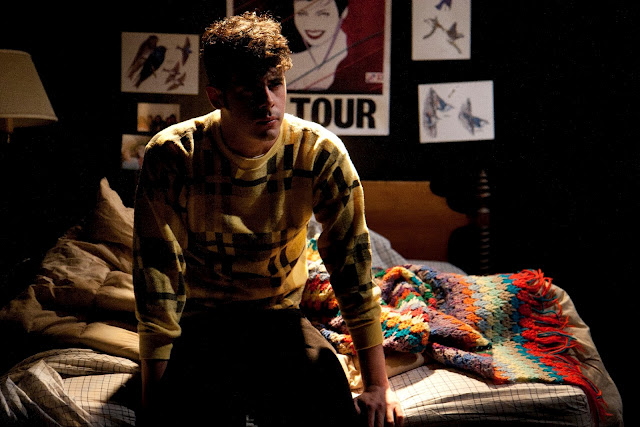
Today I interviewed J.Stephen Brantley about the personal and emotional experience of working on his autobiographical one-man show, Chicken-Fried Ciccone: A Twangy True Tale Of Transformation.


___________________________
 

What attracted you to working on this project?

J.Stephen: I told myself I would never never never do an autobiographical one-man show. How indulgent! No way. But when several different people expressed surprise that I had a history with heroin and homelessness, I began to wonder if it was a story worth telling. I was also looking to do something portable, something that might help to fund another project, and it seemed like it might work - if I could find an interesting twist. I'd been playing countrified versions of Madonna songs on my guitar for a while. The idea of marrying the two seemed ridiculous at first. But then, for a tale about a gay Texan’s personal transformation, it was also absolutely perfect!

What was your favorite part of working on this production?

J.Stephen: Working with David Drake (Director). David is a master of the one-man form and a very smart dramaturg, and an incredibly sensitive and insightful director. He led me to wonderful new places with the script and challenged me to fully engage in a style with which I had very little experience. There is absolutely no way I could have done this show without him, nor would I have wanted to. It was very much collaborative labour of mutual love.

What was the most challenging part of working on the production?

J.Stephen: People assume that my revisiting some of the darkest time of my life, and revealing all the sordid details of my addiction, would be the most challenging parts of this process. But I live with those things every day, so it wasn't so hard. What was challenging was singing and playing guitar while I did it. I'm not really a musician, I just love the troubadour tradition of marrying song and storytelling. But it's really hard to do at all, let alone do well!

Why do this production now?

Photo by Abbey Bay
J.Stephen: David and I are both in recovery, so the story is personal for us. Still, I think we kept ourselves a bit distanced from subject matter until the moment Philip Seymour Hoffman died. We were on a ten-minute break when David saw it on Facebook. All the breath went out of me. Suddenly we both saw that this live memoir-with-Madonna-songs had more resonance, more immediacy, than we'd realized. It ceased to be a period piece, and became a kind of call to action.

What do you want the audience to come away with after watching your production?


J.Stephen:
I want people to feel empowered to make positive personal transformations for themselves, to see that reinvention is possible for anyone no matter the damage. And I want people to understand the power that the creative process has to heal and uplift even the most broken among us. 


Friday, September 21, 2012

Hard Sparks


Hard Sparks is an inspirational company that works in intimate spaces. They choose productions that promote positive change and they strive to worthy community organizations.

We caught up with Artistic Director J. Stephen Brantley to find out more about this community minded company.


What are the origins of Hard Sparks and what is the significance of the company name?
Hard Sparks takes its name from The Zohar, which is the scared text of Kabbalah. It refers to the idea that we are here to elevate the sparks of creation. I think that’s what theatre does, at its best. It’s about transformative sharing, which sounds very heart-and-flowers but trust me, nothing kicks your ass harder than striving to serve a higher purpose.

Hard Sparks chooses to work with playwrights and actors who are "early-to mid-career" Why this specific group of artists?
We don’t have anything against established artists – in fact we’ve worked with quite a few this year. But when Robert Lohman and I launched Hard Sparks, it was partly to showcase actors and writers who weren’t being seen as much, or treated as well, as we thought they deserved. It’s a long list. We’ve barely made a dent.

Eightythree Down is a pretty intense work. Was any of it based on personal experiences? What was the inspiration for this play?
It’s actually not on my personal experiences. Because I’ve been very open about my own addiction, and three of the four characters in Eightythree Down are users, there’s been an assumption that it’s based on my actual life experience. To be clear, my drug of choice was heroin not cocaine, and in 1983 I was twelve years old and living in Plano Texas, nowhere near the East Village. My party days came much later, and it was dope and grunge, not coke and new wave. What is familiar to me is Martin’s loneliness, his protective little nest and the way it is ultimately destroyed. I spent my teenage years listening to The Smiths and living vicariously through others, and I know how that kind of pain catches up to you later. Other than that? My dad really did work for the mobile communications industry in 1983 and we really did have a phone in our car!

The ensemble received a nomination and each actor has praised the tremendous trust and care that was required in the rehearsal process. How did you achieve that sense of safety and what was the result in your opinion?
Our fearless foursome – Melody Bates, Ian Holcomb, Bryan Kaplan and Brian Miskell – turned in some of the bravest performances I’ve ever seen. This has everything to do with director Daniel Talbott’s way of working with actors. He’s not ensconced behind some table or buried in the script. He’s up there, in there, with them. He’s an actor himself, and actors can sense that. They know he’s not asking them to go anywhere he wouldn’t venture himself. For my part, I just tried to remind them that what they do is extraordinary. I believe it’s sacred. And they should honor and trust the full force of the abilities. Plus I brought them snacks.

What was the most satisfying part of working on this production?
Daniel pushed me to develop the script in the room. It came along leaps and bounds, thanks to him. But I think what was most satisfying to me was watching those actors connect to one another, and work all together. Their individual IT Award nominations are well-deserved, but it’s their Ensemble nod that really thrills me. The way they collaborated was so inspiring and deeply meaningful for me. Hard Sparks is about giving artists the opportunity to do that, and I’m incredibly grateful to them for responding with such passion and generosity.

What is next for Hard Sparks?
No idea really. My goal was to fuse edgy theatre with social issues, and to partner with other non-for-profits to improve people’s lives. What I’ve found in the two short years since we launched is that just getting a show funded and on its feet is tough enough, even without trying to save the world. So we’re weighing some options and looking at different ways of doing things. As soon as we’ve worked it all out, we’ll gladly share the secret formula!


Congratulations to the cast and crew of Eightythree Down!