Showing posts with label Yara Arts Group. Show all posts

Wednesday, August 16, 2017

Dark Night Bright Stars


Created & Performed by Yara Arts Group
Directed by Virlana Tkacz
Produced by Yara Arts Gorup in association with La MaMa ETC

Nominations:  Outstanding Original Music, Julian Kytasty; Outstanding Actor in a Lead Role, Jeremy Tardy


About the Company: Yara Arts Group is a resident company at La MaMa, the acclaimed experimental theater in New York. Yara has created thirty four theatre pieces based on extensive research in Eastern Europe, Siberia and Asia featuring Yara’s signature style of multilingual dialogue and songs supported by evocative visuals and documentation.

About the Production: Dark Night Bright Stars recreates the meeting between Taras Shevchenko, the great Ukrainian poet and painter, and Ira Aldridge, the African-American actor who was much honored in Europe. The two great artists, who rose up from serfdom and slavery, could not speak to each other directly but in one historical moment, found a common language in art and song. Their meetings were documented in the diary of Count Tolstoy’s 15 year old daughter, Katya.

Actor Jeremy Tardy and Director Virlana Tkacz share their experience in creating this paradoxical work that explores communication without translation and the importance of words and their multiplicity of meanings.

-------------------------------------------------------


What first attracted you to this project?
Jeremy: The encounter of Ira Aldridge and Taras Shevchenko was very intriguing.

Virlana: When I first heard that Taras Shevchenko, a great Ukrainian poet who had been born a serf, had met and befriended the great African American actor Ira Aldridge in 1858 - I was fascinated. When I started researching the topic and learned the third person who had been at those meetings was the 14 year old daughter of count Tolstoy and that she had kept a diary - I knew this was a piece for our company.


What was your favorite part of working on this production? 

Jeremy: Working with two different languages.
Virlana: Creating the piece with the other artists in our company: Jeremy Tardy, Sean Eden, Shona Tucker and Julian Kytasty. We also took the piece to Ukraine in 2014 and learned so much more about the people and our piece by performing it in Odessa, Lviv and Kyiv.

 What was the most challenging part of working on this production?
Virlana: We were creating the piece in rehearsals - that is always hard, but when it works it is fabulous.


What did you want the audience to walk away with after seeing Dark Night Bright Stars?
Virlana: That art can transcends language, that passion speaks and can help us overcome our pasts and differences.

What was the most noteworthy part of this production for you?
Virlana: We were in Ukraine shortly after the events at the Maydan - the Revolution in 2014. We performed in Odesa just before the horrible fire and heard about as we got off the train in the next city. Kyiv was on a terror alert the day we performed but the theatre was full. In New York our audiences were very moved - even highschool kids from the the local school cried.


What did you learn from your work on this production?
Jeremy: The power and depth of the spoken word can transform lives.

What was it like working with Jeremy and Julian?
Virlana: Jeremy Tardy is a wonderful actor, very creative as a collaborator. An original musical score, created by Julian Kytasty, employs traditional Ukrainian songs which Shevchenko knew, as well as songs from AME Zion Church hymnal, a church which Ira Aldridge’s father attended. Julian performed the music on the bandura, a Ukrainian stringed instrument of the lute family. A third generation bandurist born in the US, his music combines a mastery of traditional styles with a distinctly contemporary sensibility. His collaborators have included artists as diverse as Chinese pipa virtuoso Wu Man, pioneering klezmer revivalist Michael Alpert and composer/saxophonist John Zorn. He has worked with Yara since 1998. Taras Shevchenko’s most famous book is "The Kobzar," referring to the bards who played the bandura.

Photos by Pavlo Terekhov & Lee Wexler

Tuesday, October 21, 2014

War Makes a Play

Contributed by Virlana Tkacz

I first saw Izolyatsia just over a year ago. Yara Arts Group, which I direct, was invited to create a new theatre piece for the Izolyatsia Platform for Cultural Initiatives housed in an old factory complex in Donetsk, a city in eastern Ukraine. Donetsk is known as the home of miners. I had been there once before with Serhiy Zhadan, a wonderful young writer, exploring working mines and illegal digs. So I started thinking of tunnels and what people imagine while they are underground.


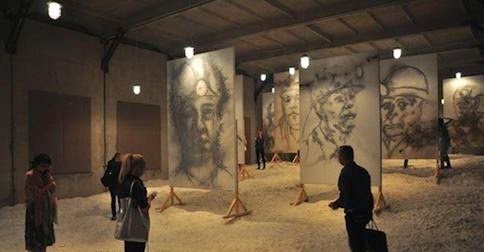
Luba Mykhailova, the founder of Izolyatsia, liked my proposal to build a tunnel, but asked that we think about people other than miners. We decided to interview young people in Donetsk and posted a note on a local website inviting people to come tell us about their dreams and their city. Over twenty people showed up. Most were in their early 20s and were overwhelmingly positive about Donetsk and their hopes. As we recorded them, our designer Volodymyr Klyuzko photographed them. We decided to create an installation based on these interviews. We made giant cubes with their photographs. As you approached each cube you could hear the stories people told us. We also started a workshop for young performers and worked on the dreams they would relate in the labyrinth we built out of huge slabs of Styrofoam the factory produced.


For our performance the audience walked on a path of yellow leaves and then entered one by one into a labyrinth of dreams. At the other end of the tunnel they came out into a large space lit up by a colorful projection. On one side were the lit up cubes with contemporary young people talking about their city. As the last of the audience entered the space we began our performance which stripped away the layers of time in the region. Donetsk was founded by John Hughes, an industrialist from Wales. Zhadan wrote a monolog for a Welsh engineer who arrived in the area in 19th century that revealed his dreams of building a new world in this area. Afterwards, there was a scene based on a story from Mediaeval chronicles about steppe nomads who lived in the region a thousand years ago. This led to fragments of poems about trees intertwined with ancient songs. Leaves fell for 150 million years in this area to create the rich veins of coal. The piece ended with a fragment of a poem by Zhadan: 

What are dreams made of?
An idea of how things should be
An aversion to how thing are
Distrust in what’s offered
And a belief in what’s hidden from us.

Then the great gate in the side of the building opened and daylight filled our dream space… Over two hundred people attended our workshop production of Underground Dreams in Donetsk  on October 10, 2013. They loved it and we were invited to return in June to create a full production.


All winter we were glued to our computers watching the protests in Kyiv that led to the fall of the government which had been led by a corrupt president from Donetsk. It seemed Ukraine was given a chance to truly break with its Soviet past. In May a new president was elected.  There was a lot of hope, but it was soon dispelled  by the crisis in Donetsk. Terrorists supported by Russian President Putin  were determined to separate this part of the country from the rest of Ukraine.  


I arrived in Ukraine on June 8, the day before terrorists captured the Izolyastia factory complex. The staff was allowed to leave with only some of the artwork and then the premises were mined.  Today, the war continues and hundreds of civilian hostages are being held there for ransom by one of the factions of the separatist army.


I met Luba Michailova in Kyiv and we decided to continue the Underground Dreams project in exile. Zhadan and I re-interviewed many of the same young people by Skype. Some were refugees in other Ukrainian cities, others were still in Donetsk. They told of morning commutes to work that meant enduring up to six searches at the armed posts set up by various factions. They talked of the difficulty of concentrating on work when people with guns ran past the window, the terror of walking through a totally abandoned downtown during lunch, the cold sweat induced by any loud noise once they had lived through a bombing raid. These interviews described the reality of war on very personal level.  We decided to include excerpts of these interviews in the show. 


Our piece about the dreams of young people from Donetsk became about the difficult reality of their lives. The audience listened to these tapes as they walked through the numerous corridors that led into the main space of the theatre. They had to pass through a metal detector, sit in a cramped locked room, watch a woman try to pack all her belongings in two small suitcases, read projected phone texts to realize that the “good job” promised one of the characters was to fight on the other side. 


Zhadan wrote poetry and monologs based on the stories we heard. One young man from the Carpathians told us he had built twelve large wooden buildings for a vacation complex near Donetsk. He showed us the pictures of the construction and then whispered the name of the place. We had all heard it. The place had recently been bombed and many people died. We found a video someone had posted on YouTube of the burning complex which we used in the show.  As the projected flames enveloped the wall of the theatre, the doors flung open and four young women from Donetsk who had been in our workshop, but  were now refugees in Kyiv, entered the space with suitcases. Tanya Hawrylyuk sang Zhadan’s poem.


Take only what is most important. 
Take the letters. 
Take only what you can carry. 
Take the icons and the embroidery, take the silver… 
We will never see our city again.

We kept the scenes with the reverse history of the area, but now they took on much deeper meanings. What happened to the utopian vision of the new world in this place? The nomadic tale of sense memory inspiring a return home, now reminded everyone that they too wanted to return to their homes as they were before the crisis.  We repeated excerpts of the original interviews. They were so beautiful, so naïve, and truly unattainable dreams today. 


We presented the new version of Underground Dreams at the Les Kurbas Theatre Center in July and were invited to perform in September at the GogolFest International Art Festival, held at an old factory complex in Kyiv.  The two performances were sold out. A reviewer from Donetsk wrote:
Underground Dreams is such an emotional, powerful and deep piece, it is simply not possible to fill a performance with more pain... It is a good that they show the war and the situation of the refugees to people in Kyiv. People in other regions simply do not understand what it means to be a refugee – to be forced to flee from your own home.”

---------------------------------

Virlana Tkacz is the artistic director of Yara Arts Group, a resident company at La MaMa Experimental Theatre in New York. She has created 25 original theatre pieces with Yara which have premiered at La MaMa and performed in theatres and festivals in Ukraine, Central Asia, Siberia, Mongolia, China and Canada. Her piece Fire Water Night was nominated for two New York Innovative Theatre Awards this year.


Friday, August 22, 2014

Fire. Water. Night

Fire. Water. Night
Conceived and Directed by
Virlana Tkacz 
Produced by Yara Arts Group in Association with LaMaMa

Nominations: Alla Zagaykevych and Lemon Bucket Orkestra is nominated for Outstanding Original Music; Fire. Water. Night is nominated for Outstanding Production of a Musical

    Photographs by Volodymyr Klyuzko

About this Production
Fire. Water. Night by Yara Arts Group adapted spring and summer rituals into a World Music Theater piece that moved throughout the lobby, risers and playing areas of La MaMa’s Ellen Stewart Theatre, reveling in the imagery of the spring thaw, of awakening forests and of midsummer fire rituals. The work, conceived and directed by Virlana Tkacz, interwove performances in English and Ukrainian, including fragments drama, poetry, dance and song. It featured a score by electronic music composer Alla Zagaykevych, traditional ritual songs from Ukraine and raucous dance music by Toronto’s Lemon Bucket Orkestra. The experience was highly visual and musical and is completely accessible to all audiences which followed the performers to witness and take part in the scenes.

Director Virlana Tkacz, and composers Alla Zagaykevych and Mark Marczyk (of Lemon Bucket Orkestra) give us some insight into the creation of this sight specific production that explores the relationship between nature and technology.


-----------------------------------------------------


What attracted you to working on this project?

Virlana: I wanted to address our disruption of the cycles in nature and the simultaneous disappearance of an entire layer of traditional culture. The production moves through the spaces of La MaMa’s Ellen Stewart Theatre to explore our relationship to water, trees, fields and our entrance into a digital landscape. I wanted to retrace this journey viscerally for the audience, make it engaging and fun, yet chilling. Through various levels of engagement the audience becomes a participant or witness to the constantly moving performance, becoming immersed, activated and taking part in the action. We move from elements deciding to turn into a frozen river, to a rushing spring flood, to the first entrance of people into a forest, to the transformation of this landscape into an agricultural field, to a harvest that becomes mechanized and digitized to the elements deciding to freeze.

Mark: The opportunity to work with Alla Zagakevich and living in New York for a few weeks

Alla: I was excited to work with such a wide arsenal of artists. As a composer, I was given the opportunity to work with all a variety of performing artists - instrumental group "Lemon Bucket Orkestra", vocal group, performing Ukrainian folk songs and soloists that sang in different manners ... and - the possibilities of electronic music.

What was your favorite part of working on this production?

Virlana: I loved the moment when the women appeared high up on the bleachers and sang the traditional songs that were used to chase the spirits into the forest. Then they come down the steep seating platforms of La MaMa clapping and chasing our living forest through the audience that was sitting on carpets on the floor. Then the curtain in back opened to reveal the three-sided huge projections of a magical forest and as we turned, we found ourselves sitting almost in the center of this beautiful and strange new world.

Mark: Making music.

Alla: The most interesting part of the project was creating the music for the different performance mediums. We created music for projections, and actors, and dancers and an interaction of these elements

What was the most challenging part of working on the production?

Virlana: The challenges were many: I had to convince one group of performers that they were going to play trees and have them work for hours on movement with our choreographer, Shigeko Suga. Another group performed songs in a language they did not know and in a manner that was totally foreign to them with Alla Zagaykevych. It was also hard to rehearse a site-specific piece in a rehearsal hall. But once people really understood how everything related viscerally and in space, it all came together.

Mark: Sitting around and waiting to make music.

Alla: The most difficult part was the combination of different cultural environments in this production. The main text was originally Ukrainian that was adapted by Lesya Ukrainka into English but there were still lines and lyrics in different languages and the artists themselves were from a number of different cultures.


What was the most interesting part of working on this production?

Virlana: Working with so many people from so many places many quirky and funny things happen, but I was most moved how all these very different elements and people came together in the performance.

It was also great that the midsummer night party we created as an intermission in our show that involved the public singing and dancing often spilled out after with the performers singing and dancing in various parts of New York.

Alla: It was very interesting to watch the performers discover how to sing with the "voice of the wind" or the “voice of fire" And I was very impress by how quickly and masterfully everyone learned all of the elements.


What do you want the audience to come away with after watching your production?

Virlana: The environment and culture are deeply linked. Traditional culture, with its special magic and joy, disappears as agriculture transforms into mechanical and our landscape becomes digital. I want the audience to think about, or more importantly to feel and experience what we are losing and what we are gaining.