Showing posts with label Jonothon Lyons. Show all posts

Saturday, April 16, 2011

Innovative Theatre


Contributed by guest blogger of the week, Jonothon Lyons.


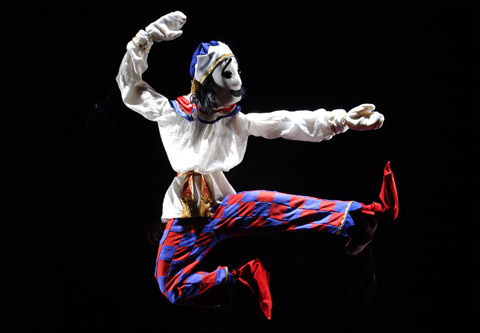
Today we finish up our two week run of Petrushka in Philadelphia and head back to New York tomorrow. On Monday I officially begin my life as a member of Blue Man Group. I'll be performing in the show here in in New York at the Astor Pace Theatre until the first week of July at which point I'll be sent off to join the company of one of the other cities: Boston, Chicago, Las Vegas, or Orlando.

I don't have a strong desire to leave New York as it has been so beneficial for my growth as an artist over these past six years. I have rarely been for want of a project to be involved in or an event to attend. The people I meet almost every day are some of the most vibrant, committed, hard working, expressive, and caring individuals I'm likely to run into anywhere. And even though I chose to go down a very niche path in the arts, New York has provided me with many vibrant and practical opportunities to pursue it.

In spite of these strong feelings for New York I'm also equally excited by the chance to be exposed to other major cultural hubs. I feel like this is an important time for my artistic development so it is of unquestionable value to me to spend a few years outside the city, finding out what people are up to in other places. Besides, I know I won't be able to stay away for too long.

Training into Blue Man Group has taken me to my limits once again. The rehearsal experience is different from any other show I've worked on and it's been exciting to be pushed in so many new directions. Once again all of my experiences with mask performance, puppetry, and movement have proved vitally important In helping me through the development process.

When I set about to discover and hopefully find work in some kind of alternative theatre, Blue Man became an immediate goal of mine. Finally making it into the show after so many years is basically a dream come true and I look forward to seeing where it takes me.

Thanks for following my entries this week, it's really been enjoyable revisiting some of my experiences. If you're interested in finding out  more about any of the companies I've worked with or want to ask me any questions please check out my website jonothonlyons.com or send an email to jonothonlyons@gmail.com.

Thanks to the Innovative Theatre Awards for promoting and supporting the Off-Off Broadway community, where so many alternative theatre styles are given the opportunity to grow.


Friday, April 15, 2011

Building The Tenement


Contributed by guest blogger of the week, Jonothon Lyons.
 
The mask theatre productions from Imago are not specifically geared toward children but are family friendly none the less. After a couple years performing these shows for predominately young or family audiences I became interested in the possibilities of mask performance for an adult audience.

My initial idea was a giant rat. I pictured a large mask that I could wear over the top of my head while squatting down in a contorted position. I didn't think far beyond the mask itself for a long time as I had never constructed anything and didn't know what materials to use or how to go about it.

In the Spring of 2009 I had the opportunity to stay in Portland a few extra weeks before returning to New York. I stayed with a friend in his spacious artist live/work space in the industrial district. After one day of doing nothing but smoking cigarettes, drinking beer, and watching snowy rabbit ear television I knew I needed to take on a project or it was going to be a depressing couple of weeks. I asked everyone from the theatre for advice on mask building and went to an art store the next day.  Equipped with everything I needed to papier mâché and an enormous block of clay I set about sculpting the face of a naked mole rat.

I was instantly fascinated with the process of sculpting. If something started to look strange I could just add more clay or smooth it out and start over. I have never studied art but I did model for life drawing classes in college and picked up information along the way. I knew to keep checking in with the source image I was tying to recreate and also to constantly realign myself with what I was making to it wouldn't become lopsided or disproportionate.


When I finished the sculpture and started layering the papier mâché I was very pleased with how well it had come together. It was a wonderful feeling to have finally put together this object I had been imagining for so long. As this was my first experience with a visual rather than performative art I was struck by a profound difference between the two: performance is ephemeral, visual art is permanent.

My whole life I had put so much time and energy into the work I did but the results of that labor could only be seen during the few short times a performance was happening. Suddenly I was holding this object that represented so many hours of work and creative energy that I could show to anyone at any time.

What continues to excite me now about the types of theatre I'm involved in, mainly mask and puppetry, is that they are a crossroads for performance and visual art. A puppet or mask is often a beautiful sculpture in and of itself but it also comes to life under the temporal circumstances of a performance.

Now that I finally had the major physical element I needed, I started to put together a context for the rat. It started as a short piece that I thought would be maybe ten minutes long.

A man sits alone in his apartment eating from a bowl. He is approached by a giant rat. They face off and he catches the rat in a cage. On his way to the door the man mysteriously falls over dead. Time passes and the rat breaks free of the cage. The rat approaches the man's body and begins to eat it. When he is finished eating the clock strikes twelve and the rat stands up, becoming the man. The man/rat sits down and continues eating from the bowl.

Not long after I had finished the mask I received an email from Ximena Garnica asking if I wanted to present a short piece at an upcoming event for students of the Cave butoh programs. It was a perfect opportunity to get this project together so I told her I would love to. Without an external deadline I don't think I would ever get anything done.

One benefit of this piece is that it required very little in the way of props or set. The only major scenic element required by the initial concept was a giant cage for the rat to be caught in. I had also been playing with the idea of incorporating some kind of projection into the piece like a window to the outside world. While I was trying to work out how to construct and rig a giant cage from the ceiling at Cave my brother suggested we simply project the cage onto the wall. This proved to be a pivotal realization for the future of the show.

I was very lucky at the time to be living with my close and long time friend Daniel Brodie, who happens to be a rather experienced projection designer. When we realized the cage could be projected we decided to project as much of the set as possible. The original short piece featured the cage and a clock projected on a solid wall upstage, and a door projected onto a curtain through which the characters could enter and exit.

It was exciting how effective the projection of the cage became when it dropped down onto the rat. Because the image was actually being projected on top of the actor it really played up the illusion that he had been caught inside the cage. The other unexpected impact of the projections I really enjoyed was the effect on the door. Even though the audience was aware that the actors were pulling a curtain aside for their entrances and exits, it still felt very much like they were using the dingy water logged wooden door that was projected upon the curtain.

Soon after that we applied for a spot with HERE Arts Center's Autumn Artist Lodge and were accepted. We planned to expand the length of the show to about a hour, add two characters and several locations, and had about twenty days from finding out we were accepted to loading in. I was able to scrape together about six hundred dollars with which to produce the show.

I began writing a script for this longer version much like the example I gave earlier. I would describe the stage action in as much detail as possible and include my thoughts on what would be projected and what music or sounds should be present. I found myself writing in a screenplay format because so much of the script was visual and it felt natural to describe the transitions as fades or cuts.

For promotion we went into Times Square with the rat costume and I ran around in the street while everyone else filmed with their cellphones or flip cameras. We didn't know how people would react but soon we found if I stayed in one area for a bit a small crowd might gather. I didn't do much other than rush toward people to scare them or have the rat drink from a puddle so we were pleasantly surprised to find that people remained interested. The most amazing thing that happened that day was that I was confrontedby a dog.  He passed by with his owner then turned and squared off with me. When I started toward him he began barking. We felt like that was the ultimate validation of the success of the mask, confusing a fellow animal.

One of the most exciting elements to watch come together were Brodie's projection effects. We once again played the show against an entirely projected backdrop but this time built a specified frame with two symmetrical doorways cut into the drop. The characters would exit through a door in the interior of a location, then enter through the same door after the projection had become the exterior of that same location. We also had subway scenes in front of a projected cross section of a subway car with the tunnels passing by in the windows.

Because we were unbarred by any physical set pieces outside of a table and a few chairs we were able to create a wide array of diverse locations in a very small space.

Ultimately the run of the show was a bit melancholy as we had a difficult time getting people out to see it. With such a short development period we also knew there was a lot that we could improve upon with more time. In spite of those feelings, however, the show did grow quite a bit over the course of it's ten performances and by the end we knew we had created something pretty interesting.

Though remarkably stressful, it was also incredibly rewarding to finally produce my own work. It has also proven helpful in finding other work as a performer as I have been asked to submit material for auditions and before this I didn't have anything to send in. It was a huge learning experience and I feel much more prepared for the development process on the next project. It's also my hope to one day bring back The Tenement so that we can perhaps share it with a larger audience.

Thank you for reading my blog this week. Tomorrow I'm going to write just a short conclusion for the week and a little bit about my experience of joining Blue Man Group.


Thursday, April 14, 2011

Physical Performance and Butoh


 Contributed by guest blogger of the week, Jonothon Lyons.


During my first few months working for Imago in 2006 I began to explore other forms of movement theatre. I did a search online for "physical performance" and came across a video of Imre Thormann performing a butoh dance improvisation at an outdoor shrine in Tokyo. I was stuck by the intensity of focus and delicate clarity of his movements. He exhibited a profound control over his body that I found remarkable. His body type was similar to mine but with a much more refined musculature and because of the similarities I felt that his level of development might be something I could aspire to. I knew then that this mysterious butoh dance, whatever it was, was going to play a major role in my physical development.

When I returned to New York the following Spring I was passed along an audition notice calling for physically trained actors and dancers for a piece called A Timeless Kaidan for the 2007 New York Butoh Festival. The audition was a rigorous, hours long workshop that took me to my limits of strength and endurance but I made it through and was delighted to have had my first introduction to butoh. The audition took place at Cave Art Space, a multi purpose studio and collective residence in Williamsburg and was led by the director of the show Ximena Garnica.


My first involvement with the project was spending three days at Robert Wilson's Watermill Center where the show was in residency for one phase of it's development. There I was introduced to the principle dancers, one of which had worked directly with a founder of butoh, Tatsumi Hijikata. I was fortunate to find myself suddenly involved with artists so knowledgeable about this performance style that I had only recently become interested in.

It can be difficult to define exactly what butoh is. It is often called a dance but it veers away from many aspects of most of what we call dance. A more accurate description is that it is a form of physical expression or physical performance. There is often music accompanying a butoh performance but the movement doesn't necessarily follow the structure of the song. Also the imagery and body positions found in butoh often do not arise from a need to create an external picture or form but from some internal imagery of the dancer.

The first performance I witnessed was rather unsettling. The dancers made strange slurping sounds and moved in what looked like very uncomfortable ways. It seemed strange to me to find value in a performance that made me uncomfortable but as I continued watching I eventually experienced a catharsis. Once the performance had ended it seemed to have had a therapeutic effect on me. I felt better afterward then when it began, as though the discomfort of the performers had purged something negative from inside me.

We trained for four months in preparation for Kaidan and I was immediately drawn to the training process. We spend hours on end simply walking back and forth through the space as slowly as possible holding a soft focus gaze on the opposite wall. It was a remarkable test of concentration to remain focused on the task under such restricted circumstances. Many other exercises pushed me to explore my limits of physical endurance over and over.


The following year the Cave began the New York Butoh-kan, a series of programs bringing in major butoh masters from around the world for ten day long intensives in their various styles of training. They have continued this program through the years and I have been fortunate to attend many of the sessions, including one led by Imre Thormann himself. It has been a wonderful resource for learning about butoh from first and second generation dancers and teachers.

What sets apart this type of work from ordinary physical exercise is that there is often an imaginary circumstance that buoys you through the stress. The exercises associated with butoh training are usually the result of imagining the body being pushed by an outside force or changed by something within. The entire basis for the movement method created by Michizo Noguchi is imagining the body as a sack full of water. Given that the body is literally 60% water, that isn't much of a stretch.

I initially pursued butoh because I was drawn to the physical results of the training and experience but over time I was surprised to discover how strongly it had helped to develop my imagination and mental stamina as well. This ability to stay concentrated and allow for an open imagination under severe physical stress and uncomfortable circumstances has proved applicable in all my experiences as a puppeteer and mask performer.

A major element that seems to exist across many of these alternative forms of theatre I've been seeking is that the performers often create their own work as well. This is especially true among puppeteers as they often not only operate puppets but design and construct them as well. After a few years of working with the beautiful masks at Imago and studying butoh improvisation and choreography at Cave I felt ready to take a stab at creating some original work of my own. The end result would be a mask theatre production called The Tenement, a collaboration with my close friend, projection designer Daniel Brodie.

Tomorrow I'll talk about our experience creating The Tenement and the benefits and challenges of producing Off-Off Broadway theatre.
 

Wednesday, April 13, 2011

Discovering Puppetry


Contributed by guest blogger of the week, Jonothon Lyons.


Last summer I had just finished my fourth season working for Imago and while it was an incredibly valuable time for my growth as an artist I was starting to feel that my professional experience was lacking diversity. I had continued to stay busy in New York between seasons developing some of my own work and performing in some other small projects but no other major professional work had come my way. I was trying to consider what other avenues I might explore to find work that fit my sensibilities when I received a call to audition for a show called Warhorse.

The casting notice was seeking tall strong physical performers with puppetry experience. When I researched the show and found out the details of the job I was dumbfounded. Up to that moment I hadn't considered my niche as a performer possible of bringing me anywhere near Broadway but all of a sudden I was going up for a leading role in a huge Broadway production that was exactly the kind of performance work I had been focusing on for so long.

I didn't make it into the show but I still felt lucky to have been called back and essentially invited to participate in two three-hour long workshops with the Warhorse puppets. I felt like I had given a good showing and had a sense that this experience was a turning point in my career and good things would come of it.

Sure enough two weeks after that audition I received a call from Tectonic Theater Project asking me to participate in a development workshop for their upcoming puppet opera El Gato con Botas. They had been given my name as a recommendation from someone at Warhorse. This was such a great example of something very few young theater artists understand: you're never auditioning for just one project. Everyone in the room is going to work on other projects later and also know several other people doing the same thing, so if you're not right for the show you're auditioning for at the moment that doesn't mean you won't be right for the next show.


 El Gato con Botas is a chamber opera for children and for this production the animal characters and the ogre were puppets. By the end of the workshop I was operating the cat puppet along with two other puppeteers. This style of puppetry is derived from Japanese bunraku puppetry which features three puppeteers operating one puppet. For this character I was operating the right arm and body, a second puppeteer, Stefano Brancato, was on the head and left arm, and a third, Aaron Schroeder, was on the feet.

Much like when I first began working with masks, this process introduced me to several new unique aspects of performance that were different from anything I had done before.

The most important of these new elements was the sense of collective awareness. Some form of this exists in all stage performance that has more than one performer, but when you are sharing the performance of one character between three people, you have to be extremely sensitive to what all three are doing absolutely every moment of the show.
In the beginning of the process there were plenty of times when the cat would try to walk one way but his head would go another, or he would try to jump in the air but couldn't because his legs didn't leave the ground. Our director, Mark Down, would ask us to take it very slow, focus deeply on the puppet but keep a strong periphery awareness of the other two performers and breath audibly together. It felt very strange at first but soon became second nature and eventually we began to settle into a sort of unspoken language of breath.

The three of us developed the ability to cue each other through a slight gesture of our part of the puppet, coupled with a preparatory breath, to move right or left, jump or fly through the air, walk, run, or tiptoe. It took a remarkable amount of concentration and many frustrating hours of uncoordinated movement but when we started to get it it was one of the most exciting feelings I've had performing.

The show was eventually blocked out and the movement set in place but along the way we had achieved an ability to improvise with the puppet in a cohesive and honest way. Far from just moving an object around the stage, by the end it felt like the three of us were working together in collaboration with a living character.

I remember as a young actor I would always take deep offense if a fellow actor gave me notes about my performance. It seemed totally inappropriate and only the role of the director to do so. But in this type of performance with three actors sharing a role we had no choice but to give and accept notes to and from each other. There were times when one of us would have an impulse that the others did not have and we would have to justify it or reach a compromise. A positive benefit of this process is it really keeps one's ego in check. If any one of us was unwilling to reach a collective understanding and give and take ideas and impulses, we wouldn't have gotten anywhere.

I was very lucky to follow up this experience by joining the cast of Basil Twist's Petrushka which we performed in Boston in November and is currently running through Saturday at the Annenberg Center for the Performing Arts in Philadelphia. This show also features a modified bunraku style but with a different arrangement of the puppeteers: one on both arms, one on the head and body, and one on the feet. Much of the same wordless cueing occurs though and of course the performance requires a strong sense of collective awareness.

I also recently helped in the development of Tom Lee and Matt Acheson's Secret History of the Swedish Cottage at the Swedish Cottage Marionette Theatre in Central Park which is running through November. This was an exciting opportunity because it brought me in touch with stringed puppets for the first time, requiring a more delicate style of manipulation through a more obscured view of the puppet.

It was an exciting discovery for me that puppetry was a vibrant and popular form that features the same alternative performance elements that I've been seeking. The focus is not on the individual performer, it is often based heavily in movement, and always has a strong sense of visual storytelling.
Tomorrow I'll be talking about some experiences with Butoh dance work and Cave Art Space. 


Tuesday, April 12, 2011

Imago Theatre and Mask Performance


Contributed by guest blogger of the week, Jonothon Lyons.


As soon as I was out of school the only thing I could think of was getting back in. I had already been considering graduate school a viable option for me and after seven months of relative inactivity in New York, going back to school seemed like the best thing I could possibly do.

The most appealing program I found was the "Lecoq-Based Actor-Created Theater" program at Naropa University. I didn't know who Lecoq was but I liked the sound of actor-created theater and it appeared to have a strong focus on physical movement. As I researched I began to realize that the teachings of Jacques Lecoq were precisely in tune with the kind of work I wanted to become involved in.

Not long after this the audition for Imago came around. As soon as I found out the company was also Lecoq based I knew it was going to be to my liking. It seemed almost fated that while considering an educational program focusing on this specific style of work, I came across an opportunity to experience it through direct application. I ended up working with the company for four years so it feels akin to having been through a graduate program in Lecoq based mask performance, of course with the upside of a reverse tuition situation.

To learn more about Imago's history and see some of their other works please visit their website imagotheatre.com.

When I began my first performances in Frogz I was immediately struck by some major differences of mask work from the traditional acting experiences I had had. One was the total anonymity of the performers. Because everyone is completely costumed head to toe with full masks covering their heads, the group onstage instantly becomes a collective with no focus on any individual performer. Though certain performers will have solos or appear onstage more often, the audience has no way of knowing who's who and so no individual is given credit over another.

Something about traditional acting that always seemed strange to me is the suspension of disbelief about the actor playing the role. Especially with famous actors, the audience is never fully engaged in the character alone, there is always some level of recognition about the specific actor they are watching. With mask performance, there is no way to know which actor is playing the character, so the character stands alone. A performance in this style really depends on talent and craft, there is no getting by on good looks or charming mannerisms.

It was exciting for me to discover this element of mask performance because l no longer  felt like I was tinkering with my own psychology to produce the performance.

Another major difference is the character's relationship to the audience. In most traditional narrative drama there is a firm separation between the audience and the world of the play. In Imago's productions and most mask performance in general it is the complete opposite. The strength of character often depends on how directly the audience is connected. The characters are constantly checking in with the audience, looking directly at them as if the gauge their reaction to any given moment. 

One of my favorite pieces to perform in Frogz is called orbs. The actors are completely hidden inside these enormous fabric spheres and melt off the front edge of the stage right on top of the front row of seats. The orbs then fan out through the house grabbing programs, rustling hair, and sometimes dragging children across the isles. I love this piece because the actors are as far as possible from the audience visually and yet they are as close as possible to the audience physically.

Another unexpected skill I gained from working with Imago was learning direct object manipulation. There are a few pieces they do entirely under black light with the performers covered head to toe in black velour body suits. We operated giant under sea creatures and flocks of birds and dancing rubbery strings. In a piece called Windbags I had to operate a tiny accordion puppet doing backflips and facing off with a much larger version of itself.

Since the company is known for mask work we always considered ourselves strictly mask performers and even though the shows feature a fair amount of puppetry I never thought of myself as a puppeteer. It wasn't until about a year ago that I realized I had in fact been developing those very skills for four years. I started going out for puppetry auditions and making it through and was delighted to discover another form of theater performance that was movement based with little focus on the individual performer.

Check back in tomorrow for the next post, I'll be focusing on puppetry and object theatre.

Monday, April 11, 2011

Alternative Forms


Contributed by guest blogger of the week, Jonothon Lyons.


Slava's Snowshow

Like most theater artists, I grew up performing regularly at the local community theaters in my hometown. My first role was at nine years old as the part of "Man #2" in Rumplestiltskin. I specifically remember that incidental character title because when a friend of my parents asked for my autograph after the show, I signed it without a hint of irony, "Man #2."

As a child, I was never drawn to the aggressive and competitive nature of sports and was baffled by the elusive nature of talent in visual art, but something clicked for me when I was performing on stage for a live audience. I made it a priority to be involved in some production or other as often as possible and knew early on that I was going to continue to keep that priority as I grew older.

I was lucky to live in Phoenix, a city that strongly supports charter schools, and attended a performing arts magnet high school downtown, thus avoiding the anxiety I had assumed would be facing me at public school. At Arizona School for the Arts I was introduced to a strict and uncompromising approach to pre-collegiate theater training.  We were taught to consider acting a very serious and difficult pursuit. Through our lessons in class I began breaking down into tiny beats every thought and motivation my characters had and finding justification for those choices somewhere within myself. It was there I first experienced the teachings of Stanislavsky, Uta Hagen, and Sanford Meisner.

I continued training as an actor in these styles at Arizona State University and never considered that I would be anything other than an actor performing traditional narrative psychological drama. It was what I had always done and what I loved to do, but in my final semester, I had a traumatic experience that reshaped my perspective on acting and theater performance and ended up being a major turning point for me.

Just before my final semester at ASU I attended a two week acting workshop in Vancouver, B.C. and met a girl. We quickly entered into ill-conceived long distance relationship and after a few months I started to realize we weren't standing on very firm ground. I eventually broke it off with her and her reaction was to accuse me of falsehood throughout our entire experience together. She was convinced that I had lied about my feelings for her and was able to do so easily because of my acting. The last thing she said me was, "you're a very good actor, but also I'm extremely gullible."

I was devastated that the strong emotions I had felt were perceived as fake, and I started to question myself. I became worried that all of my psychological acting training had damaged my ability to live in reality. I began to constantly analyze my daily choices and motivations and soon there were moments when I interacted with others when I felt like I couldn't tell if I was acting or not.

I feel strongly that the art one creates and the process of that creation should be therapeutic rather than destructive. When I felt so damaged because of my artistic pursuits, I knew that something had to change. I still wanted to pursue a career in live performance and theater but I no longer felt like this traditional style of psychological acting was going to work for me.

I began to consider a step in a new direction and started to think about the kinds of productions I had seen over the years that had really moved me.  I realized that it was rarely traditional classic narrative drama that I was affected by but the more spectacular movement and visual based shows like De La Guarda or Slava's Snowshow. I loved De La Guarda so much I saw it each time on three consecutive visits to New York during college.

My final semester landed me in classes about Brecht, avant guard theatre, and reshaping our concepts of what theater is supposed to be. I had a formative experience with a movement for actors class that lead me to begin telling people I wanted to be a "movement theatre artist."

This was mostly met with confusion and when pressed to clarify, I actually could not really explain what it meant. But I knew that in order to continue working in theater, I had to get out of my head and into my body, and movement based theater sounded like what I was looking for. I had a relatively uneventful first year in New York. I went on a couple of embarrassing auditions and enrolled in a few acting classes that reaffirmed my lack of connection to traditional acting training.

Frogz
Finally I came across an audition for a mask theater show called Frogz looking for "physical performers with the grace of a dancer, the depth of an actor, and the timing of a comedian." Within twenty minutes of twisting, turning, and leaping through the space and performing several exercises improvising with gibberish, I knew I had found what I was looking for. After my third callback, I was hired as a full time company member of Portland's Imago Theatre and ended up spending four years with them. My experience at Imago gave me the foundation in mask, puppetry, and movement based non-dialogue performance that has brought me many fruitful opportunities in professional theater over the last few years.

Please check back here tomorrow for my next post. I'll explain more of what Imago does and explore some of the major elements of mask performance.

Sunday, April 10, 2011

Guest Blogger of the Week: Jonothon Lyons


We loved hearing from our friend Jeff Riebe last week.

We are excited to announce that our guest blogger for next week is Jonothon Lyons.

Jonothon Lyons is an interdisciplinary theater artist living in New York City. He has worked over the last five years primarily as a performer in mask, puppetry, and physical theater. He was a performing company member with Imago Theatre from 2006 to 2010, has toured internationally with Imago’s signature mask productions Frogz and Biglittlethings, and in the Spring of 2009 he became a member of the original cast of ZooZoo. Imago's productions are created and directed by Jerry Maouwad and Carol Triffle and based deeply in the mask theatre performance style of Jacques Lecoq. In September 2009 he collaborated with projection designer Daniel Brodie on an original mask theater piece titled The Tenement which ran at HERE Arts Center as part of the 2009 Autumn Artist Lodge. The Tenement was nominated for eight 2010 New York Innovative Theatre Awards including Outstanding Production of a Play and Jonothon received the award for Outstanding Original Short Script. In October of last year he was a puppeteer on the title character in Moisés Kaufman’s El Gato con Botas at the New Victory Theatre. The production was a collaboration between Tectonic Theater Project and Gotham Chamber Opera with puppetry by Nick Barns and Mark Down of Blind Summit Theatre from London. In November he joined the cast of Basil Twist’s Petrushka and performed at the Paramount Theater in Boston. Petrushka is currently in performance at the Annenberg Center for the Performing Arts in Philadelphia through April 18. Jonothon also worked under Twist in 2009 at Tandem Otter Productions helping to build the puppets for The Addams Family: A New Musical. Other New York credits include Alive 1 at English Kills Art Gallery, A Timeless Kaidan at Theater for the New City, both by Garnica LEIMAY performance company, Beyond the Mind by Allie Avital Tsypin, RAN at HERE Arts Center, and The Secret History of the Swedish Cottage by Tom Lee and Matt Acheson. Most recently Jonothon has joined the New York company of Blue Man Group and will be performing as a Blueman at the Astor Place Theatre through July.