Tuesday, October 30, 2012
Volunteer to help OOB productions
Dear Community Dish Friends,
I hope all is well in your worlds. Sandy definitely did a number on our City. Obviously if you're reading this you're getting internet, which is probably more than most. The thoughtful Sean Williams reached out earlier with concern for the community...
"I know that someone got screwed. One of our theaters has to have gone underwater, some facility got completely nailed and there have to have been a couple dozen shows on the off-off level that were either supposed to load out or load in this week."
So let's be there for our fellow Indie Theatre folks. You can volunteer to lend a hand by emailing
amandaellenfeldman at gmail dot com
IF ANYONE NEEDS ASSISTANCE PLEASE LET US KNOW. A volunteer list will be posted later this afternoon. Let's see if we can coordinate a handful of volunteers to send your way!
AND if you have extra time on your hand to volunteer (because your office is closed), email the Red Cross - staffing@redcrossny.org or go to their website.
Be well and stay dry!
Amanda Feldman


Friday, October 19, 2012
Mint Offline Social Interaction
Hey Net Pals,
My BFF and I were looking to disconnect from the info tube, venture wirelessly for an evening and try something authentic; you know some sort of nondigital connectivism. I pinged my contacts and got a P2P response with 411 on this thing called “theatre” or “theater” ???
\’thee-uh-ter, theeuh\ n 1: a building designed for performances 2: the world of actors, theatrical companies, etc
I thought it sounded totally mint, but It turns out that this thing has been around like 4EVs. And I’m like “Am I Code 11 or just completely Code 404?”
We were given an ETA and told 2b@ a certain place. It was sort of like a PUG or a flash mob, because a bunch of other people showed up 2. I was like “OMG this is 2G2BT.” We all went into this CSA space that was sort of like a synchronous chat room, but in RL. I f2f IM’d the guy next to me to check out his status. He poked me back. ♥
It got really dark and when they ttlo these people came out as avatars and interacted with user generated content. Srsly it was like 3D live streaming, but offline. My BFF was all “this is OTW.” I LOL. I had TIME. I had the BTE.
At the end, there was LLTA and I was all, “this is kickass crowdsourcing.” I was going to google the network of participants, but they had already tagged the avatars in an e-reader made out of paper that they downloaded to the audience. It was so awesomely old school.
Afterword my BFF, the rhgir and his friend DM’d one another and continued the thread at the bar next door. It was a gr8 night. WOOT WOOT!
Are you seeking an experience that is: live, multi-platform, interactive, immediate, social, 3D and peer-to-peer; something you can do with a friend, a fan, a member, a follower, list, groups, forums or networks? Then bookmark your favorite OOB company and set your protocol to receive: updates, messages, posts, tweets, newsfeeds, RSS, and invites.
It is sure to be the BTE! ;-)
End of Message
BFF = Best Friends Forever
P2P = Peer-to-Peer
411 = Information
4Evs = Forever
Code 11 = Out of Date
Code 404 = Clueless
ETA = Estimated Time of Arrival
2b@ = To be at
PUG = Pickup Group
OMG = Oh my god
2G2BT = Too good to be true
CSA = Cool Sweet Awesome
RL = Real Life
f2f = face-to-face
IM = Instant Message
OTW = Out of this world
ttlo = turn the lights on
Srsly = Seriously
LOL = laughed out loud
TIME = tears in my eyes
BTE = Best time ever
LLTA = Lots and lots of thunderous applause
rhgir = Really hot guy in the room
DM = Direct Message
Gr8 = great
Thursday, September 27, 2012
3 New Awards Presented at IT Ceremony
This year at our awards ceremony we introduced 3 new awards.
The Doric Wilson Independent Playwright Award
This award was named in honor of a true Off-Off-Broadway pioneer and a dear friend. Doric Wilson was a radical, pioneering, innovative, and unflinching playwright and New York theater artist. He was one of the original playwrights of the Caffe Cino, the author of many extraordinary plays, and the creator and artistic director of TOSOS (The Other Side of Silence). The success of his plays at Caffe Cino helped, in the words of playwright Robert Patrick, to "establish the Cino as a venue for new plays, and materially contributed to the then-emerging concept of Off-Off-Broadway." His Now She Dances!, a fantasia on the trial of Oscar Wilde, was the first Off-Off-Broadway play to deal positively with gay people. Under the mentorship of producer Richard Barr, Wilson became a pioneer of the alternative theatre movement, dedicating his career to writing, directing, producing, and/or designing hundreds of productions. Through his work with TOSOS, and because of his unwavering love and belief in playwrights and the theater, he was a mentor and friend to many young writers and helped foster the future of their plays.The award named in Doric’s honor will be given to a playwright whose writing and work ethic honors the innovation, uncompromising vision, heart, and spirit that was Doric Wilson and his work. Writers working in the five boroughs of New York City who have not received an Off-Broadway, Broadway, or prominent regional theater production are all eligible.
The 2012 Doric Wilson Independent Playwright Award Committee includes: Jennifer Conley Darling, Mark Finley, Julie Kline, Daniel Talbott and Kathleen Warnock.
The inaugural recipient of this award is Donnetta Lavinia Grays a playwright that Doric knew well; someone who Doric supported and mentored. She is a writer of singular vision, and unparalleled ability.
Congratulations Donnetta!
Outstanding Revival of a Play and Outstanding Premiere Production of a Play
Just after last Thanksgiving, we asked you, the community at large, to discuss a series of questions we’d been facing, to get your feedback, and give you the opportunity to share your ideas.We asked about our rules and requirements such as ticket prices and budget caps (all good reads), but the topic that got the most traction by far was the discussion about award categories. Specifically many members of the community championed the idea of there being a category for revivals. It wasn’t a completely cut-and-dried issue: there were many voices, backing the many angles of the topic, and there were aspects to adding such a category that are complicated to be sure. But ultimately, it was clear that the community wanted the new award and perhaps most importantly it gave us the opportunity to recognize more artists and more outstanding work.
So, in direct response to your input, we created 2 awards; Outstanding Revival of a Play and Outstanding Premiere Production of a Play. These two awards replace “Outstanding Production of a Play.”
The Revival category includes classics, established plays, or the production of any script that has previously received a full production (this excludes workshops or readings).
The Premiere category includes plays that are, as the title indicates, receiving their premiere production.
This season Ajax in Iraq produced by Flux Theatre Ensemble received the Revival award and Advance Man produced by Gideon Productions received the award for Premiere Production. Both are worthy recipients and we are happy that we are able to recognize both of these outstanding productions and exceptional companies.
Congratulations to both.
And congratulations to all of the nominees this year. There is so much inspirational, engaging and innovative work happening in our community - we could not be more proud.
Friday, September 21, 2012
Hard Sparks

Hard Sparks is an inspirational company that works in intimate spaces. They choose productions that promote positive change and they strive to worthy community organizations.
We caught up with Artistic Director J. Stephen Brantley to find out more about this community minded company.
What are the origins of Hard Sparks and what is the significance of the company name?
Hard
Sparks takes its name from The Zohar, which is the scared text of
Kabbalah. It refers to the idea that we are here to elevate the sparks
of creation. I think that’s what theatre does, at its best. It’s about
transformative sharing, which sounds very heart-and-flowers but trust
me, nothing kicks your ass harder than striving to serve a higher
purpose.
Hard Sparks chooses to work with playwrights and actors who are "early-to mid-career" Why this specific group of artists?
We
don’t have anything against established artists – in fact we’ve worked
with quite a few this year. But when Robert Lohman and I launched Hard
Sparks, it was partly to showcase actors and writers who weren’t being
seen as much, or treated as well, as we thought they deserved. It’s a
long list. We’ve barely made a dent.
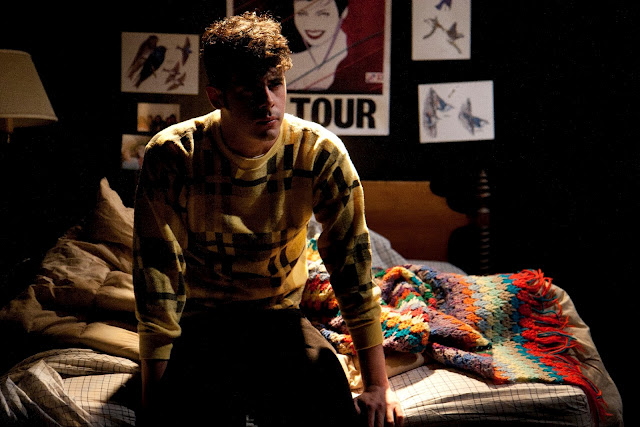
It’s actually not on my personal experiences. Because I’ve been very open about my own addiction, and three of the four characters in Eightythree Down
are users, there’s been an assumption that it’s based on my actual life
experience. To be clear, my drug of choice was heroin not cocaine, and
in 1983 I was twelve years old and living in Plano Texas, nowhere near
the East Village. My party days came much later, and it was dope and
grunge, not coke and new wave. What is familiar to me is Martin’s
loneliness, his protective little nest and the way it is ultimately
destroyed. I spent my teenage years listening to The Smiths and living
vicariously through others, and I know how that kind of pain catches up
to you later. Other than that? My dad really did work for the mobile
communications industry in 1983 and we really did have a phone in our car!
The ensemble received a nomination and each actor has praised the
tremendous trust and care that was required in the rehearsal process.
How did you achieve that sense of safety and what was the result in your
opinion?
Our
fearless foursome – Melody Bates, Ian Holcomb, Bryan Kaplan and Brian
Miskell – turned in some of the bravest performances I’ve ever seen.
This has everything to do with director Daniel Talbott’s way of working
with actors. He’s not ensconced behind some table or buried in the
script. He’s up there, in there, with them. He’s an actor
himself, and actors can sense that. They know he’s not asking them to go
anywhere he wouldn’t venture himself. For my part, I just tried to
remind them that what they do is extraordinary. I believe it’s sacred.
And they should honor and trust the full force of the abilities. Plus I
brought them snacks.
What was the most satisfying part of working on this production?
Daniel
pushed me to develop the script in the room. It came along leaps and
bounds, thanks to him. But I think what was most satisfying to me was
watching those actors connect to one another, and work all together.
Their individual IT Award nominations are well-deserved, but it’s their
Ensemble nod that really thrills me. The way they collaborated was so
inspiring and deeply meaningful for me. Hard Sparks is about giving
artists the opportunity to do that, and I’m incredibly grateful to them
for responding with such passion and generosity.
What is next for Hard Sparks?
No
idea really. My goal was to fuse edgy theatre with social issues, and
to partner with other non-for-profits to improve people’s lives. What
I’ve found in the two short years since we launched is that just getting
a show funded and on its feet is tough enough, even without trying to
save the world. So we’re weighing some options and looking at different
ways of doing things. As soon as we’ve worked it all out, we’ll gladly
share the secret formula!
Congratulations to the cast and crew of Eightythree Down!
Congratulations to the cast and crew of Eightythree Down!
Tuesday, September 18, 2012
FullStop Collective

Since 2007 the FullStop Collective has been producing new and innovative work. This last season they took on a musical set in a landfill in the future.
Producing Director, Leta Tremblay shares a little about their company and working on Unville Brazil.
Producing Director, Leta Tremblay shares a little about their company and working on Unville Brazil.
What were the origins of the FullStop Collective?
What inspired Unville Brazil?

What are the challenges of producing a new musical?
The music! Music added an entirely new set of challenges to producing a new play. Originally we hoped to have live musicians on stage throughout the performance but it quickly became apparent that this was not feasible for us for this production. Our backup plan was to prerecord all of the music and incorporate it into the sound design. This actually turned out to be a great solution because the actors were able to rehearse with the recordings (they still sang live) and we had more control over the volume and balance of the music in performance.
Did you incorporate green practices into the production?
Absolutely. This was a huge initiative for us. Nearly the entirety of our set was constructed out of recycled materials. The play takes place in a landfill so it was actually easy for us to collect recycling from the cast, crew, and community to build our set. We also chose to go almost entirely paperless with our programs. Cast bios were posted on the lobby walls and on our website along with other pertinent information. Water and wine was served during intermission in reusable mugs that were returned after use and washed at the end of each show. We sold FullStop branded tote bags to encourage our audience to use reusable bags when shopping rather than constantly bringing home plastic.
What was your favorite line in the production?
This is such a hard question! Pat's writing is so poetic and there are so many beautiful lines in this play but I'm actually going to answer with some lyrics from the opening song:
I know,In this beginning is the thesis for the journey that this musical takes you on. For me, the play is a call to arms in the form of a love story. It speaks to where our world is headed if we continue on in this way with disregard for how we are affecting the lives of future generations. But it also speaks to the doubts that we all face as individuals. Have I made the right choices? Is this all that there is to life? Unville Brazil 's answer is that there is always more to be done, and always time to begin again.
This seems like the end
Of ice caps, trees, and the inter-specicial friends
I know,
You think you're at the end
Of the world
But then again
There's much more to be done
There's plans and dreams and history to be spun
You're not giving up when you know it's time
To begin again
What is FullStop currently working on?
FullStop
Collective just wrapped Cause of Failure at the 2012 New York
International Fringe Festival this summer to great reviews and an
opportunity for the play to be published on Indie Theater Now! Next up,
we are producing Outfoxed, a new play by Lucy Gillespie, at Access
Theater November 29 - December 16. And Brian reprises his role as
director. Here's the teaser:
A bookish American student abroad gets in over her head in a life of sex and drugs.
Her mother gets a phone call…
I hope that you'll check out www.fullstopcollective.org in the coming months for more details and join us at the theater this winter!
A bookish American student abroad gets in over her head in a life of sex and drugs.
Her mother gets a phone call…
I hope that you'll check out www.fullstopcollective.org in the coming months for more details and join us at the theater this winter!
Thursday, September 13, 2012
Magic Futurebox
Magic Futurebox employs 'story theatre' to produce some incredibly visceral and intriguing work.
Co-Founder and Executive Artistic Director, Kevin Liabson explains their esthetic and how this form of theatre engages and excites audiences.
What are the origins of Magic Futurebox and what is the significance of the company name?
A couple of years back, my now-partner Suzan Eraslan was working as Programming Director for The Tank. She took me on as a theater curator there. At the time, I was working with a different theater company, and as we embarked on a big series at The Tank - the Public Domain series - my partners at that company all got married and had babies all within a fairly small time frame. As such, Suzan stepped in to help with a lot of the production aspects of Public Domain. Before we knew it, we were producing together full time. Immediately after Suzan left The Tank, we were given the opportunity to move in to our space in Brooklyn, and it's been pretty non-stop ever since. We're currently running, I believe, our twentieth production in 2 years.
In terms of the name, it's not a great story - when we realized that what we were doing constituted running a company, and needed to get our LLC, and thus a name, we spent a day or so throwing possible names around. As you do when you're naming something, a possibility would come up, and we'd google it and see if it was taken. Suzan suggested something, I said, "let me look it up on the old magic futurebox," which was just how I occasionally referred to my laptop, and she hit me and asked why I'd been holding that phrase out on her. It stuck. Tommy Smith, who wrote Demon Dreams (and two other shows we've produced), called it "the eventual result of producing all of these shows - it's the thing we're gonna open in the future, and we'll look back and see everything that's gone on and realize that we are in the future as a result of opening that magic futurebox in the first place," which I like better.
Tell us what 'story theatre' is? and why do you choose to work in this form of theatre?
 Story
theater is a form wherein actors both narrate and play the story. As
an actor mimes opening a door, he might say "the baker creaked the door
open and crept through." He then may continue to narrate or enter in to
dialogue, but he never (or rarely) exits the story, exactly. The form
was created by Paul Sills while he was working with the Game Theater in
Chicago in 1968. The form requires no sets, costumes, or props - all
factors of the environment are suggested by the actors through
spacework, and often a shadow screen. A small group of actors play
several characters each, and usually, there's a circle on the floor
which is used as a guideline for travel, passage of time, etc. It's an
incredible form when it's done well - it allows the audience to
experience storytelling and theater the way that children do, but
without any sort of pandering or condescension. It's a form that allows
for wonder and awe. I had the good fortune to work with Paul on
several story theater productions while I was at the New Actors
Workshop, either as an actor, musician, or lighting designer, and then
stage managed several more for Jason Hale, a student of Paul's and a
real master of the form.
Generally, story
theater is applied to a collection of folk tales or classic stories. I'm very interested in applying the form to other work. I feel like
there are so many ways in which other media has theater beat in it's
effectiveness, and the only theater that really excites me is that which
capitalizes on its form. Story theater, for instance, doesn't work on
screen. Or hasn't yet. I want to make theater that has to be theater. Story theater allows the audience to involve themselves in the creation
of the piece by imagining the wall separating the two young lovers, as
the actors simply lean on the space between them. If we're gonna get a
whole bunch of people in the room for something, shouldn't we invite
them to play?
Demon Dreams incorporated live music. What were the benefits and challenges of this?
Music's a pretty integral part of the story theater form, and Tommy capitalizes on it beautifully in the script to Demon Dreams. Because the form is so open and playful, audiences are totally willing to accept songs and underscoring - anything that helps shape the environment, tonally or otherwise. We brought in the Wiz Kids, a couple of DJs who had invented a wearable turntable set (TurnTableTar) to play the shows, and Paul Miller aka DJ Spooky generously provided tracks for us to use as the beats for lyrics Tommy had written. Having live musicians is a huge boon to a story theater show, as the music and the sounds they can provide further shape the environment. Most of our sound effects were variations on record scratches and such, and we focused on underscoring the show the way you would a Warner Brothers cartoon. Having the flexibility of live musicians playing with the cast, we were able to allow the cast to improvise physical choices a lot more than if we were tethered to a sound board.
Music's a pretty integral part of the story theater form, and Tommy capitalizes on it beautifully in the script to Demon Dreams. Because the form is so open and playful, audiences are totally willing to accept songs and underscoring - anything that helps shape the environment, tonally or otherwise. We brought in the Wiz Kids, a couple of DJs who had invented a wearable turntable set (TurnTableTar) to play the shows, and Paul Miller aka DJ Spooky generously provided tracks for us to use as the beats for lyrics Tommy had written. Having live musicians is a huge boon to a story theater show, as the music and the sounds they can provide further shape the environment. Most of our sound effects were variations on record scratches and such, and we focused on underscoring the show the way you would a Warner Brothers cartoon. Having the flexibility of live musicians playing with the cast, we were able to allow the cast to improvise physical choices a lot more than if we were tethered to a sound board.
What has the audiences reaction been to Demon Dreams and your other productions?
Demon Dreams was pretty well received. Basically, it's a fun, high-energy children's show questioning the innate goodness or evil-ness of human beings. What's not to love, right? Our shows seem generally to be fairly popular, but it's a tough question. I'm not out to shock or offend anybody, but I don't think everybody should like everything. People who thought Demon Dreams was too silly or frivolous loved Firemen, another of Tommy's shows we produced, which was anything but. Theater is for audience, absolutely. But any given piece has its own audience, and not everyone is a part of any given audience. If everybody likes what we're doing, then we're not doing our job.
Demon Dreams was pretty well received. Basically, it's a fun, high-energy children's show questioning the innate goodness or evil-ness of human beings. What's not to love, right? Our shows seem generally to be fairly popular, but it's a tough question. I'm not out to shock or offend anybody, but I don't think everybody should like everything. People who thought Demon Dreams was too silly or frivolous loved Firemen, another of Tommy's shows we produced, which was anything but. Theater is for audience, absolutely. But any given piece has its own audience, and not everyone is a part of any given audience. If everybody likes what we're doing, then we're not doing our job.
What was the most satisfying part of working on this production?
I was (and continue to be) super duper in crazy love with the cast. They were 6 of the most giving, collaborative people I've ever worked with, and I'd do anything for them. So much of my job for this show was just to set up an environment wherein they could play around until they found something wonderful. I really just got out of their way. Only one of them, Joe Burch, had worked in story theater before (Joe and I both played Hanrahan in Paul Sills' adaptation of Yeats' The Stories of Red Hanrahan), and teaching the conventions of the form to these lovely, playful people was incredibly satisfying. It's such a cool form, and working with pros who'd never really seen it before served to reinforce my love for it.
I was (and continue to be) super duper in crazy love with the cast. They were 6 of the most giving, collaborative people I've ever worked with, and I'd do anything for them. So much of my job for this show was just to set up an environment wherein they could play around until they found something wonderful. I really just got out of their way. Only one of them, Joe Burch, had worked in story theater before (Joe and I both played Hanrahan in Paul Sills' adaptation of Yeats' The Stories of Red Hanrahan), and teaching the conventions of the form to these lovely, playful people was incredibly satisfying. It's such a cool form, and working with pros who'd never really seen it before served to reinforce my love for it.
What is next for Magic Futurebox?
I think I can officially announce that we're extending our current show, Open Up, Hadrian, which we're co-producing at our space with Caborca Theater through Sept. 29th. We've just started rehearsals for Bloody Lullabies for Brave Women, a new piece my partner Suzan commissioned from Miranda Huba, which will be a very limited run to benefit the New York Abortion Access Fund. We've also got the Deconstructive Theatre Project in residency at our space working on The Orpheus Variations, which will run at our space Oct.19-28th, and we're about to start casting The Carnivorous, a play by Julian Mesri, the focus of our Playwright Spotlight this year. The Playwright Spotlight program focuses on one writer a year - MFb produces three of their plays, showcasing the breadth of their work. Last year's Spotlight was Tommy - Demon Dreams was the second of his pieces we produced. We're also working with Tommy on a new show, hopefully for Spring, but it's in the earliest stages of development. We have about 5 other projects in some stage of development, as well as upcoming workshops and residencies. I know that's a lot of information, but there's even more at magicfuturebox.com.
I think I can officially announce that we're extending our current show, Open Up, Hadrian, which we're co-producing at our space with Caborca Theater through Sept. 29th. We've just started rehearsals for Bloody Lullabies for Brave Women, a new piece my partner Suzan commissioned from Miranda Huba, which will be a very limited run to benefit the New York Abortion Access Fund. We've also got the Deconstructive Theatre Project in residency at our space working on The Orpheus Variations, which will run at our space Oct.19-28th, and we're about to start casting The Carnivorous, a play by Julian Mesri, the focus of our Playwright Spotlight this year. The Playwright Spotlight program focuses on one writer a year - MFb produces three of their plays, showcasing the breadth of their work. Last year's Spotlight was Tommy - Demon Dreams was the second of his pieces we produced. We're also working with Tommy on a new show, hopefully for Spring, but it's in the earliest stages of development. We have about 5 other projects in some stage of development, as well as upcoming workshops and residencies. I know that's a lot of information, but there's even more at magicfuturebox.com.
Subscribe to:
Posts (Atom)